TASK 1
Finding a studio that I aspire to work for, and make a product that will fit their audience and style. I am expected to produce a piece of work in that studio's style and theme. The limitations I may encounter are not having the experience to produce a UI in the right theme of the studio. The theme of my chosen studio is quite universal, as they like to experiment and try new ideas, therefore I can be quite liberal with my ideas.
Deadline - 24th September 2021
Research into game aspects

After experimenting with each area and trying out the sub options, I have decided that I will go with UI design for my project, because it's interesting to research how audiences react and use different kinds of user interfaces and how each element corresponds and relate to other elements.
Studio Research
Conducting research into different studios.
Media Molecule
Media Molecule's audience are creatives. They like to create things without limit. This shows greatly in the things their community have made in Little Big Planet and Dreams. Because of this audience, they are building tools for these games to encourage this creativity, like in Dreams, there's a DAW, 3D modelling, animation, and loads more. By meeting these needs in their most recent game "Dream", they allowed the creative audience from Little Big Planet to move over easily, and then get those players to recommend it to other people, further increasing its player base and audience, which in turn helps the other players because of the amount of content being uploaded for others to use.
Media Molecule has engrained themselves in creative experiences, with Tearaway being a less customer focused creative game, and more of a creative mechanics game, which is a microcosm of their studio.
Valve
Valve has split audiences. Some of them are hardcore multiplayer fans of Counter-Strike or DotA 2, and some are focused on the singleplayer experiences, like the Portal games and the Half-Life games. Some of these players speedrun and some use them to create entertaining content within Valve's various software, like Source Filmmaker and Hammer. By supplying these tools for each game, Valve are meeting their creative audience's needs as those people can create anything they want and see it in action either in game or with an animation. For the more hardcore multiplayer fans, Valve release skins and items in DotA 2 and CS:GO to not only get more money, but also to incorporate the community's creations, as each case they release in CS:GO features skins made by players who then get paid for their contribution. As for trends in the company, Valve are notorious for having no third title in any of their game series. They also rarely release new games, with Half-Life Alyx being their only big, successful game for the past 7 years.
Game Freak
Game Freak are famous for making the Pokemon series of games. They ensure their audience needs are met by creating each Pokemon game with incredulous levels of helping the player. They do this because they target the younger audience, who may not know what's happening a lot of the time, so this constant player helping does help with that. However, this has a huge negative impact towards the older players, most of which are hardcore fans of the series. These players want a challenge, and never get it, and so slate Game Freak for their lack of consideration towards this audience. Game Freak are known for releasing two Pokemon games at once, both having exactly the same contents, but just with small differences like certain Pokemon only being in one game and not the other. This at first was a good idea, but as the years have gone on, it's turned into a gimmick which people dislike, as the differences between the games get few and far between.
Why I chose Valve
Justification
I picked Valve because they're the company I look up to the most in terms of their work ethic as well as their views on making games. They're completely fine with brand new and whacky ideas that could work. They actively try new ideas and work with new technology to create the best experiences. By allowing this creativity, I am not restricted to a certain type of game and style. I can branch out and experiment like Valve themselves do.
Valve like to try out ideas on new technology, even if it means alienating some of their audience, like with Half-Life Alyx being VR only. This lets them innovate as much as they can to improve the gaming scene like they did with most of their previous games already.
Statistics
Valve have one of the highest, if not the highest, player count in their games compared to any other studio. Counter-Strike and DotA 2 are both the highest and second highest played games on Steam respectively. Their main platform they release games on is Steam, with The Orange Box and Portal 2 releasing on consoles, but the vast majority of their games are released on Steam.
Target Audience
Valve's target audience is a mismatch of players. Some are professional players in games like DotA 2 and CS:GO, some are casual players in those games, some are collectors in those games, some are fans of their single player experiences like Half-Life and Portal, some are speedrunners of said games, some are modders of both single player and multiplayer games, some create content (like maps, items, skins) for games and get paid for it, etc. Valve were able to release Half-Life Alyx because the majority of people who know about Valve at least partially would know that Half-Life 2 was the most recent Valve-released Half-Life game. Valve followers have been waiting for a "Half-Life 3" for over 15 years, and Half-Life Alyx mostly made it worth while (to the people with VR headsets).
Valve's Target Audience
Age
The age demographic for Valve games is early teens to late 20s (roughly), therefore I will aim my game towards that for the target audience. This means I'm not restricted with what I can put in the game, although it would be best to aim for a 16 or 12 rating to include the younger teens. It also means I don't need to worry about appealing to young children and making it entertaining for them, I can instead focus on storytelling, environments and making the game generally more fleshed out as these ages will be able to understand the significance of each event compared to the wider story.
Interests
Valve seem to target their single player games a little towards the horror side, with Half-Life being a game about aliens and includes scenes where Headcrabs start the process of making a zombie with a human (jumping on their face). This helps the player become interested in the story of the game because nothing is censored to protect the player, everything is raw. Because of this, the player has a heightened sense of awareness and also feels more immersed.
Purchase intentions
The purchase intentions of Valve customers depends on the type of game. If it's a single player game like Half-Life, then the intentions are to get immersed in the story and wonderful level design. If it's a puzzle game like Portal, then the intentions are to not only follow the story, but to complete each puzzle in a timely manner. If it's a multiplayer game like CS:GO, then the intentions are to have fun and also grind to improve and rise in the ranks.
Popculture
Including popculture into my game would help it reach a wider audience of people who may not have known about the game before. Valve don't include popculture in their games much at all, so if I was to follow in their footsteps, I wouldn't include any. However, if an opportunity arises in which a franchise or film, etc. appeals to the audience that my game is targeting, then it would be worth it to include official content in the game, or even something as small as an Easter Egg.
Brainstorming Ideas


ENTITY
-
A puzzle game where entities from the game engine appear within the game world. The player must destroy all the entities in each level, however when an entity is destroyed, its function stops too.
Genre:
First Person

FULL MOON
-
A single-player story-based exploration game where you must investigate the mysteries of a hatch on the moon. Inspired by the 2009 Renegade Kid DS Game "Moon", you must fight a series of extra terrestrials to find the meaning of the hatch.
Genre:
First Person
Unnamed game
A multiplayer game based off Takara-Tomy's Beyblade franchise. Players battle other players on 1-on-1 matches, 2-on-2, 4 player free-for-all, etc. in online multiplayer to climb ranks and leaderboards to become the best. This will also feature a story campaign with entirely new spinning tops which the player can buy using money they win from beating NPCs throughout the game.
To summarise it into the simplest form:
Pokemon but with Beyblades.
Studio Research (groups of 3)
Paradox Interactive

Paradox Bibliography:
[1] Baines, T. (2017). Paradox Interactive offers free game, DLC as payback for price hikes. Available: https://www.thumbsticks.com/paradox-interactive-free-game-dlc-07072017/. Last accessed 8th September 2021.
[2] PC Games Hardware. (2016). Stellaris Gameplay / Review / Test - Ruckeln im Weltraum. Available: https://www.youtube.com/watch?v=z5L3DuS5kqw. Last accessed 8th September 2021.
[3] moron, s. (2020). Surviving Mars – Basic Gameplay Tips and Tricks. Available: https://indiefaq.com/guides/1468-surviving-mars.html. Last accessed 8th September 2021.
[4] de Kooter, S. (2015). Cities Skylines Game Performance Review. Available: https://www.gameplayinside.com/strategy/cities-skylines/cities-skylines-game-performance-review/. Last accessed 8th September 2021.
[5] Bomb, G. (2012). Crusader Kings II - Gameplay. Available: https://www.youtube.com/watch?v=i_u31Rf8jxY. Last accessed 8th September 2021.
Bethesda

Bethesda Bibliography:
[1] Sites, C. (2015). BETHESDA E3 2015 PRESS CONFERENCE CLIFF NOTES. Available: http://www.sub-cultured.com/bethesda-e3-2015-press-conference-cliff-notes/#content-anchor. Last accessed 8th September 2021.
[2] Milo. (2017). The Elder Scrolls V: Skyrim: Special Edition (Xbox One/PS4, 2016) – Review. Available: https://stuffandthatreviews.wordpress.com/2017/04/13/the-elder-scrolls-v-skyrim-special-edition-xbox-oneps4-2016-review/. Last accessed 8th September 2021.
[3] Narcisse, E. (2014). Dishonored Is Stunning At 4K Resolution. Available: https://www.kotaku.com.au/2014/07/dishonored-is-stunning-at-4k-resolution/. Last accessed 8th September 2021.
[4] 蓬萊山輝夜. (2009). Prey gameplay. Available: https://www.youtube.com/watch?v=0zQZkpum08A. Last accessed 8th September 2021.
[5] De Meo, F. (2016). DOOM Gets New Gameplay Video Showcasing Early Game Mission, New Screenshots. Available: https://wccftech.com/doom-gameplay-video-showcasing-early-game-mission-screenshots/. Last accessed 8th September 2021.
Valve

Valve Bibliography:
[1] File:Valve logo.svg - Wikipedia
[2] Ricochet on Steam (steampowered.com)
[3] beepbeepimajeep. (2016). CSGO - AWP CLUTCH! (Counter Strike Global Offensive Gameplay!). Available: https://www.dailymotion.com/video/x4ys3ip. Last accessed 8th September 2021.
[4] gamesoverdose. (2011). Portal 2 (PS3) Gameplay Part1. Available: https://www.youtube.com/watch?v=Nz2us2JOhiU. Last accessed 8th September 2021.
[5] dumlepumle. (2016). Half Life 2 Gameplay [PC HD]. Available: https://www.youtube.com/watch?v=aLbD1pD0JCk. Last accessed 8th September 2021.
Square Enix

Square Enix Bibliography:
[1] Rogers, P. (2020). A message from Phil Rogers, CEO of SQUARE ENIX (Americas and Europe). Available: https://square-enix-games.com/en_GB/news/message-square-enix-ceo. Last accessed 8th September 2021.
[2] Noctis Lucis Caelum/Gameplay | Final Fantasy Wiki | Fandom
[3] FZ.se. (2017). Nier: Automata (gameplay). Available: https://www.youtube.com/watch?v=hYWlz8n20Mc. Last accessed 8th September 2021.
[4] consolewars. (2015). Life Is Strange [PS4] [1080p] Gameplay 2/2. Available: https://www.youtube.com/watch?v=SQ0sqUzMglk. Last accessed 8th September 2021.
[5] Romano, S. (2017). Dragon Quest XI ‘Silvia’s Parade’ gameplay. Available: https://www.gematsu.com/2017/07/dragon-quest-xi-silvias-parade-gameplay. Last accessed 8th September 2021.
Valve's Products
Art Style
If Valve had one main art style for the company, then it would be realistic, but their games vary in style a lot, so most of their games have their own unique style (e.g. Team Fortress 2 is cartoony, Half-Life 2 is realistic, DotA 2 is stylised, etc.).
Content
Almost all of Valve's multiplayer games have loot box systems for players to get items like skins and cosmetics. These are seen mainly in TF2, CS:GO, and DotA 2. In their single player games, Valve focus on an engaging story to keep the player playing.
Characteristics
Valve make a mix of multiplayer and single player games, with a mix of themes and styles in each. If they were to have a specific theme however, it would be realistic, but only in visual aesthetic. This is because Valve try to innovate and advance technology and the gaming scene with each release, seen evidently with the Half-Life series, with each major release showing off new tech or systems (e.g. HL1 revolutionised story-based shooters, HL2 revolutionised physics in games and level design, and HLA revolutionised the VR industry, being the first AAA game on the VR platform).
SADS
Short brief
SADS is a top down game about anxiety. It includes stealth elements in which the player must achieve daily, mundane tasks without attracting attention to yourself. This is because you have severe social anxiety, to the point where contact with another person increases your anxiety. There is an anxiety bar which shows how close you are to an anxiety attack, and this increases as you do things which make you anxious (e.g. walking into someone, etc.).
Valve UI Moodboard

Bibliography
Portal 2 - dangblacksheep. (2011). Portal 2 Main Menu Screen. Available: https://www.youtube.com/watch?v=qtm2U-M-lHA. Last accessed 15th September 2021.
Left 4 Dead 2 - Stahie, S. (2013). Last Chance to Get Left 4 Dead 2 Free on Steam for Linux. Available: https://linux.softpedia.com/blog/Last-Chance-to-Get-Left-4-Dead-2-Free-on-Steam-for-Linux-411984.shtml. Last accessed 15th September 2021.
DotA 2 - BAKA JERRY TO?. (2016). Dota 2 Main Menu. Available: https://steamcommunity.com/sharedfiles/filedetails/?id=790811646. Last accessed 21st September 2021.
CS:GO - HypeR_MK. (2018). CSGO New Panorama UI 2018 | Full Walkthrough. Available: https://www.youtube.com/watch?v=gzqEDOwoxQA. Last accessed 21st September 2021.
Factors that might impact my project
Risks
Not knowing mandatory software, natural disasters (flooding, power cuts), cloud storage facilities failing (can't access files/files get deleted as they can't be saved), a pandemic (like COVID-19).
Game Research
No Man's Sky:
When Hello Games was working on No Man's Sky in late December 2013, their office in Guildford was flooded, and on Christmas Eve, the water was ankle high. Storm clouds blanketed Guildford, and water from the River Thames flooded over into the office. This delayed the production of No Man's Sky by a lot as they had to clean up the office in the following days and get back to work with what they had. There were backups luckily, so they could continue work on No Man's Sky, but it was a big loss.
Halo Infinite:
There are multiple factors that contributed to Halo Infinite's delays, a big one being COVID-19. COVID prevented employees from going to work, and thus having to communicate people through online services, slowing down work and lessening morale significantly.
My own risk assessment:

Bibliography:
No Man's Sky:
Tach, D. (2014). Back to work: The story of the Hello Games flood. Available: https://www.polygon.com/2014/3/11/5487564/hello-games-flood-recovery-interview. Last accessed 20th September 2021.
Halo Infinite:
Kime, J. (2021). MICROSOFT DELAYS KEY HALO INFINITE FEATURES UNTIL 2022. Available: https://www.ggrecon.com/articles/microsoft-delays-key-halo-infinite-features-until-2022/. Last accessed 20th September 2021.
Surveying Valve's Audience
Continent of residence

Sex
Highest qualification

Age range
Religion

Ethnicity

Lifestyle
Favourite Valve series
Favourite game genre

Hobby

Do you have a pet?

Favourite UI style


Interpreting the results
Continent of residence and Ethnicity:
Most Valve fans are European, and this shows in its multiplayer games. Let's take CS:GO as an example. Most of its fanbase are European, with lots of those Europeans being made up of people from Russia. Why Russians like playing CS:GO so much is unknown, so knowing the country of residence of Valve's target audience is only really useful to dictate what content can be in the game (in case countries have rules against certain aspects of games). China for example doesn't allow skulls in games, so a skin in CS:GO had to be changed from a skull to a helmet to suit that country. I will need to bear this in mind when creating my game and to research the countries' rules that I will be targeting to make sure the game can be sold there. The Continent of residence links with Ethnicity, and most people are White, so that links with Europe being the continent that most players live in.
Sex:
The vast majority of Valve's playerbase are male, and this shows in the games they make. They mostly use a realistic style, like in Half-Life and Left 4 Dead, where it's more focused on horror and the story experience. However they do also cater towards other sexes with their other games' styles, like Portal. The characters used in the games is also important. DotA 2's character are extremely diverse, which allow all genders and sexes to choose whatever they want to play as, whereas Half-Life's character is a male, and features mostly men, especially in the first game, which would appeal more to the male sex. However in the second game, Half-Life 2, one of the main characters introduced was Alyx, a female character who accompanied you through the game. She is also the playable protagonist in Half-Life: Alyx, Half-Life's newest game. The Portal series have Chell as the main character, a female. She isn't seen much in the game and doesn't say anything, so this also lets male players insert themselves into her position.
Qualifications, Favourite Valve series, Age, Lifestyle and Favourite game genre:
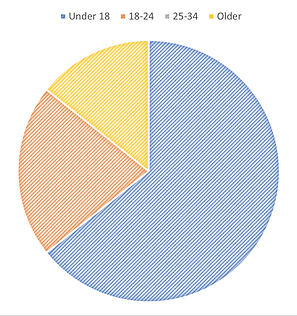
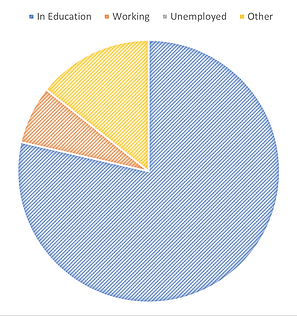
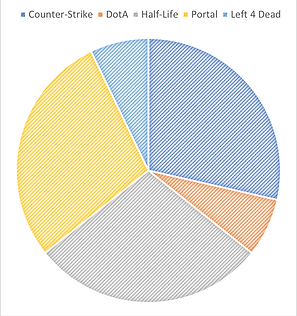
Most Valve fans either have A Levels (or equivalent to) or haven't finished school yet, showing that most of their playerbase is younger people. Linking this to the Favourite Valve series data, we can see that most people play Portal or Half-Life, with Portal being a 3 rated game (by PEGI), and Half-Life being a 12 rated game (by PEGI). This links with the qualifications and age demographic, as most players are under 18, so having two of Valve's most successful series being rated under 18 means that more players can play them, giving Valve more sales and reviews. The qualifications also links to the Lifestyle data, as most players are still in education, which correlates to the data shown previously. The Favourite game genre data also links to the Favourite Valve series data, as most people prefer FPS games, which is what Portal and Half-Life are. By continuing to develop these kinds of games, Valve are feeding their community content that they want. I will therefore make an FPS game, but an FPS game with a catch that hasn't been explored much before, if at all, which is what Valve tries to do, innovate.
Religion:
Most players are either Atheist or Other, and so since most players don't have a religion, Valve don't need to spend time looking at what content can and can't be added because of certain religions. They still need to be careful about what they do add, but to a lesser extent. This is prevalent in CS:GO, where a team of Terrorists literally try to blow up a map, and the player has to play as those Terrorists for at least half the game. Another example is general violence in games, as almost every Valve game as guns in that can shoot the player. Most if not all religions say that murder is not good, but it's included anyway because it's so far from real life that it doesn't matter too much, and that the people you shoot aren't real.
Pet:
Whether the player has a pet or not can dictate if the character in the game has an animal companion. For Half-Life 2, Valve had a robot called "Dog", which acted as Alyx's pet, similar to a dog in real life. This appealed to players who had pets, or more specifically, dogs, and they had to bond with the robot in part of the game by throwing a ball and getting Dog to catch it. This is something dog owners do a lot, so it's a touch of familiarity in an otherwise alien environment.
Favourite UI style:
The majority of people said they liked Flat UI styles the most, and this is seen in Valve's most recent games, like Portal 2, CS:GO, and Half-Life: Alyx. The second most voted for style was skeuomorphic, which is seen in DotA 2 the most. To catch on to this style and to experiment and show that I am able to make a diverse array of styles, I will create a skeuomorphic design to combine with my FPS game to incorporate elements of different game genres to try to innovate as Valve does.
How Valve games cater to audiences (in relation to Maslow's Hierarchy of Needs)
In Valve's popular multiplayer games, the player is always in a team, and that team has to complete an objective. By making the player play with a team of other people to accomplish a task, this is catering towards the belongingness side, where the player should feel like they're part of the group and are helping. New friendships may be formed from these games, and players may feel a sense of connection between each other if a plan goes well. Players can also play with friends in a pre-team against other people, and can assign roles based on their skills in the game (like AWPer, Lurker, Entry Fragger, etc.). Each of these roles work to help the team as a whole, as they are used in different circumstances, so having a team that know each other already and are friends, assigning roles is a necessity, and would be fun and interesting to do. In games like Portal 2, there is no clear role as it's co-op, so the two players must work together evenly to accomplish the goal of finding the exit. This means they must have a level of trust with each other to avoid obstacles like spike plates and acid.
These games also cater towards the player's esteem, updating the games with new cosmetics and items, allowing the player to purchase them and gain a sense of individuality and recognition, as well as having the freedom to equip whatever they please to be themselves and show off in the game. Counter-Strike: Global Offensive recently released a new operation (Operation Riptide), which directly links to esteem, as it offers new operators, gun skins, and new maps for the player to learn and master. In Portal 2, there isn't much of a reward for beating a test chamber apart from GLaDOS saying something snarky and moving on to the next one. This helps to play out the lore of the game, as the two players are robots that are subjected to endless amounts of testing in test chambers forever. However there are cosmetic items that you can put on your character, similar to Team Fortress 2, which allow for some kind individuality.
This also transitions into self-actualisation, where players can learn the new maps quickly, and therefore be the best players on those maps. Taking CS:GO as an example again, the game has a very high skill ceiling, and becoming the best at it is an extremely hard, if not impossible, job, but the desire to be the best is always there in every player's mind, because the game caters towards everyone's skill level by having ranks. These let players of all skill level play with other players of a similar skill level, making the matches even to both sides. If less experienced players faced against players in the best rank, then the less experienced players wouldn't have much of a chance to win, and the more experienced players will feel like they had an easy win, which isn't something that helps self-actualisation. So providing ranks adds a consistent level of challenge for players to overcome, making victories feel even more rewarding. Beating all the test chambers in Portal 2 is the main goal, as then you'd complete the game and finish what you started. However doing that is no small task, and so with each completed test chamber, you know there's one less that you need to complete to get to the end. Not only is there the goal of finishing all the chambers, but there is also the opportunity for speedrunning, where the person who finishes a chamber the fastest is the best. This can be done in both singleplayer and multiplayer, and so lets anyone try it.