Task 2
Communication & Application Process
UCAS Application
To make my UCAS application, I need:
Personal details:
These are so UCAS know who I am, and that I'm not pretending to be anyone else.

Contact and residency details:
This is to further prove my identity and to show that I am a UK resident.

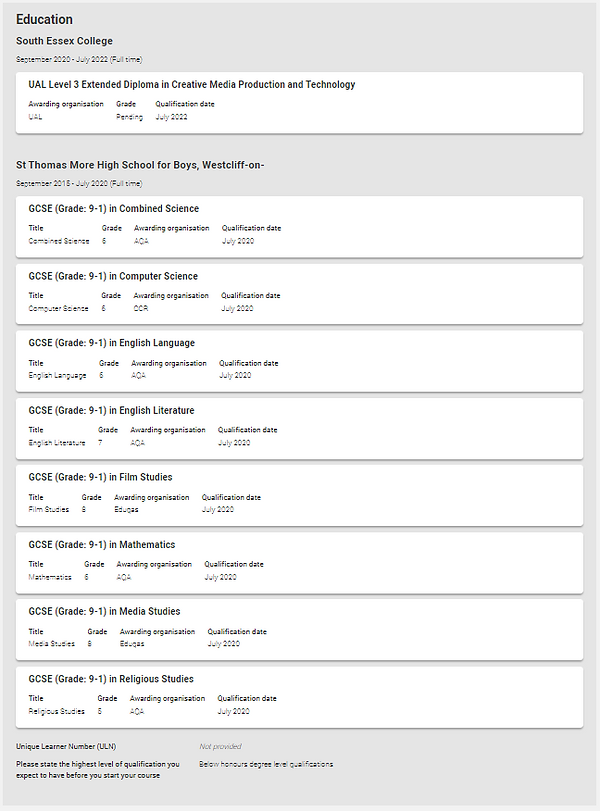
Education:
This is to tell UCAS my qualifications to make sure I'm eligible for the course I want to do.
Employment:
So UCAS knows where I've worked before, and if I've worked before.

Nationality details:
This is to further prove that I am a UK resident, and to make sure they know what my nationality is within the UK.

Supporting information:
This covers other information that supports the rest before it, like if I have a disability so they can accommodate it, etc.

English language skills:
This is to make sure I am proficient in the English language, as every university in England expects its students to be well spoken in English.

Finance and funding:
This is to make sure I, as well as UCAS, know how I will be getting funding for my studies, as the entry fees are quite high and living around the university could be costly.

Diversity and inclusion:
This is so they know things like my ethnic origin, religion, sexual orientation, etc. to make sure they include everyone.


Personal statement:
This is needed for the universities to see my skills in action, and a chance for me to tell them why they want me to be in their university.
University Choices

Personal Statement
This course really attracted me because I have been playing and creating games for a number of years, so having the opportunity to learn and expand my horizons in this field is very exciting. I have enjoyed games since I can remember, which has led me to have an interest in making them, with the ultimate goal of other people playing and having fun with them. During my time at college, as I found the course so engaging, I have put in extra work at home which has resulted in consistently high grades. In particular, I found the area of UI/UX design most interesting and is where I hope to pursue a career in the future. Apart from the actual content I have so far learned on the course, I have gained other valuable skills that will be beneficial as I move into higher education. An example of this is making surveys for playtesters to provide feedback. I have made countless small projects to try out my ideas, some of which have developed into something more and others haven't. However, in all of them, I've learned a new technique or skill that I have then gone on to use in subsequent work, such as a working tab system using a scroll box for its contents.
At secondary school, I gained nine GCSEs of grade five and above, including Computer Science which gave me a good grounding on the technological behaviour of computers and programs. I also found I did well in Media and Film Studies which gave me an insight into narrative development and improved my ability to analyse professional media. Currently, I am in my second year of a level three Games Development course which will give me a good foundation on which to commence a degree course. I am conscientious with tasks given to me and so I work best when I'm in a team of people who can also do their roles well. I like to be given specific instructions instead of being told to "be creative". I can be creative though; I just prefer to work in an ordered team with clear goals and plans so I can keep on top of the work and meet deadlines.
In my spare time, I am a playtester for a game called "Gemini: Binary Conflict". I play the game with other people and try to find bugs and glitches in the game for the developers to fix. This has helped me apply the knowledge I have gained in this field in both my own and other students' games. By practising and experimenting with different UI styles and UX layouts at home I have gained an understanding of how they work at an intricate level. I have a keen
desire to learn more in a professional environment.
At school, I was part of the small audiovisual team where I started to learn about time and project management which I have applied during my time at college. Throughout periods of lockdown, I was part of a creative team in my local church. This gave me the opportunity to work with others who have different skills and helped me to understand various parts of the
creative process. These difficult circumstances taught me there is often a solution, even if it is far removed from what I might have imagined. On reflection, my experience also showed me that a person who is flexible and adaptable is a valuable component in a team. I have the privilege of volunteering at my local Foodbank which, as a naturally more introverted person, has helped me to develop my communication skills as well as grow in confidence whilst working with the clients using the service. Additionally, through this work, I have gained valuable insight into other people's backgrounds and circumstances, and how they might differ from my
own.
If I am successful in gaining a place on this course, I would like to be a UI/UX designer and, as such, can see myself working for smaller indie teams in this area. Once I have gained a professional working background, I hope to join larger companies creating triple-A games and providing unforgettable experiences for players. My dream is to work at Valve, helping to produce the wonderful games they make, as each one has a purpose and reason to exist.
Looking at CVs

Sally Sad:
Laid out unprofessionally and in small chunks with not much information. Not much information was included, and of that information, a lot of it was informal and inappropriate language. The tone is also bright and almost childish which wouldn't work in a workplace. There is an image in the top right which shouldn't be there as it isn't needed and doesn't fit the mood of a CV.
My CV will no include unnecessary images or phrases as to make sure it stays professional. In addition, I will use a formal email, one that makes an impression on the company, and not one that I made five years ago to be funny. The layout will be similar to Sally's, but cleaner and with less childish language.
My CV:
I am a teamwork-focused person with good concentration and a self-motivated outlook. I have done volunteering work at my local Foodbank where I developed organisational and social skills, as well learnt how to be a better team member.
I am looking for a UI/UX designer job role to apply my skills to help your studio’s development in games. I have been described as “fun and enjoyable to be around, a creative mind, and determined”.
Key skills:
General knowledge of computer programming.
A deep working knowledge of user experience design.
Liaising with a team – Multiple successful group projects.
Education:
South Essex College (2020 – 2021):
Creative Media Production (Games Development) Level 3 Diploma – Distinction
St Thomas More High School (2015 – 2020):
English Language – 6
English Literature – 7
Mathematics – 6
Combined Science – 6
Religious Studies – 5
Computer Science – 6
Media Studies – 8
Film Studies – 8
Work Experience:
Site-Street – Web designer – 2017:
I helped design a website with the CEO of Site-Street.
Hobbies and Achievements:
Primary school prefect.
A YouTube channel with over 3500 subscribers making tutorials in Unreal Motion Graphics.
I play drums.
I have written a chapter of a book.
References upon request.
I structured my CV to allow me to explain about myself first so the employers know who they're reading about and to also give exposition to my achievements. This gives them a good idea of my personally so they pre-emptively want or don't to hire me. This perception can then change when they read on to my grades and skills, where they can see how qualified I am for the job position. If they had a negative view of me from my personal start, then this could change by looking at my skills and grades as they would realise that I'm actually well qualified for the role and am therefore a valuable resource.
By including my past employments, employers can see if I'm non-committal (if I have lots of past jobs) or if I don't have much experience (very little past jobs). Straight after are my hobbies/interests where I state my personal likings, and show that they can be used in a workplace for the job role. Letting the employers gain an insight into my personal life allows for both a greater connection between both them and me, as well as a deeper look into how I gained my skills (as my hobbies help with the field I wish to work in) and also what I like to do in my free time (if I'm productive with lots of other hobbies and am passionate, or if I'm lazy and don't do much else). If at this point the employer is uncertain, or wishes to know more about my personality and how I work, they can contact my references for a first-hand opinion of myself to then make up their mind from the reference's experience. Because I am relying on the references, I will need to keep my composure and work ethic to create an impression on them for a good reference.
COVER LETTER
Salutation: Gabe Newell @ Valve Corporation
I am writing to express my interest in the Valve Corporation. I have recently finished a degree in graphic design/game design, and want to be a UX Motion Designer for new games. I found this position on your website, and would love to work in this job because I’ve been fascinated with the idea of smooth and elegant user interfaces, and wish to apply that in this position. I have been a fan of Valve ever since I started playing Team Fortress 2 in 2015, and have significant amounts of time in multiple Valve titles (mainly CS:GO), and so I understand the general philosophy of how a Valve game UI should function.
I have a degree in graphic design/game design, and spend lots of time self-educating myself on what makes a UI intuitive and fun to use. Part of this self-education is asking other people to use the UI so I can get thorough and informative feedback on the flaws and successes of it. This allows me to get other people’s perspectives on the interfaces I create and lets me put myself in their shoes to understand the problems of these interfaces and how I can fix or improve them.
I have created multiple user interface designs and concepts, most of which I feel would work in Valve games that have already been released. I am also intrigued in working on VR UIs, and the challenges that they will bring, and since Valve is interested in the future of gaming, I should be too, so making VR user interfaces will be a new challenge to overcome.

I wrote a cover letter for the UX Motion Designer job role at Valve. This will benefit my progression by showing Valve that I am interested in their company and have a passion and desire to work for them. In it I stated that I am interested in the future of gaming and am willing to learn more about virtual reality game development.
LinkedIn is a professional social networking service that lets employers and employees connect and hire in a social network setting.
This is my account:

I made an account on LinkedIn so that it's easier for me to show myself to potential employers, and for them to find me. By adding my qualifications and CV to my profile, employers can quickly see if I am right for the job. I will add a profile picture to future cement my identity as a future employee, so that employers know who they are hiring before doing so.
LinkedIn also lets people message others privately, so smaller studios can message me if they need employment.
LinkedIn lets me add my skills and endorsements to show anyone who views my page what my skills are and if I am the right person for the job. It also lets me add an "About Me" section where I can give my point of view on my own work and try to convince potential employers why I am the person for the job.
Student Finance
Nationwide:
Nationwide say they are the only fee-free student bank account in the UK, but also say that I need to pay £500 for each term from the date I open the account.

Fiverr and Upwork
I researched Fiverr and Upwork to see if they were applicable to me and my work, and currently don't feel like I want to go down the freelance route. However that could change if I try it out and like the workflow of freelancing.

Fiverr is quite well known for its vast amount of users, being featured in videos where people pay different amounts of money for the same brief to see which is the best, and these help me to judge the price that I should put on myself, and also see the competition and how to get in the spotlight and have people find me.
If I were to create a Fiverr account, this would benefit my progression as I would be getting jobs from clients that I can use both as an educational experience, as well as work for my portfolio, and examples of professional practice in the industry. This will also give me a form of income that I can use for university and when applying for jobs. I can also show my Fiverr account to employers for them to see how I handle clients and how good my work is through the star ratings and comments from clients stating their opinions on my work.

Upwork is more professional than Fiverr, and so has less users. However the prices tend to be more on Upwork because it is a more professional platform. I am also a lot less knowledgeable in Upwork, so if I were to become a freelancer, Fiverr would be the website I'd use first, with Upwork coming second after mastering how Fiverr works.
Applying To Jobs
A good way to get noticed by employers is to post my work on social networking sites like Artstation, Twitter and LinkedIn, and add hashtags to them so anyone searching for those hashtags can easily find them. This helps me get a foot in the front door as professional employees will see my work and make note of it if it is of good quality and could benefit the studio.
I can make my own small games to show off my skills, and make extremely polished, short demos to show that I not only have a working understanding of the beginning of creating a game, but also a working understanding of the finalising and polish of making a game, and am able to finish things. By working with other people in an indie studio, I can show that I work well with others and therefore am able to work well with industry professionals on AAA games.
Participating in game jams will also help a lot, as it shows that I can work under pressure and with people I don't know. This will shows employers that despite any differences that there may be in a group, I can work around them and produce a game as a result with all my effort.